How to properly set up a welder for different materials?
All about welding machines
11.06.2025
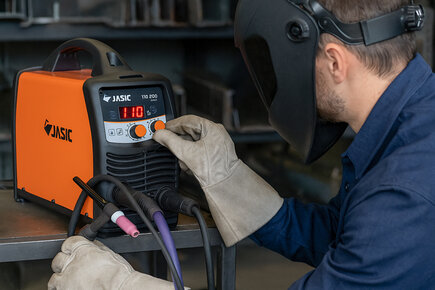
Proper welder settings are essential for a high-quality, strong, and safe weld. Each material requires different parameters – here is an overview of how to adjust them based on welding type and material.
🔧 1. Basic parameters you set:
- Welding current (A) – determines weld penetration depth
- Voltage (V) – especially for MIG/MAG; affects arc width
- Wire feed speed (for MIG/MAG)
- Shielding gas flow – usually 8–15 l/min
- Type of electrode / wire / shielding gas mix
🧱 2. Recommended settings by material:
➤ Steel (carbon)
- MMA: 90–140 A for 2.5–3.2 mm electrodes
- MIG/MAG: CO₂ or Ar+CO₂ mix, current 100–200 A
- TIG: direct current (DC–), tungsten electrode 1.6–2.4 mm
➤ Stainless steel
- MIG/MAG: Ar+CO₂ or Ar+O₂ mix, stainless wire
- TIG: DC–, argon as shielding gas, current approx. 80–150 A
- Gas flow: 10–12 l/min
➤ Aluminum
- MIG: argon, aluminum wire (e.g. AlMg5), higher current (120–220 A)
- TIG: alternating current (AC), aluminum tungsten, 100% argon
- Surface cleanliness is essential!
➤ Copper / brass
- TIG: argon, AC or DC+, higher current (due to thermal conductivity)
- MIG: special filler materials and fine speed adjustment
⚙️ 3. Additional Setup Tips
- Thicker material = higher current
- Thinner sheets = lower current and short arc
- Overhead or vertical welding = lower current, shorter arc
- Synergic machines (MIG/MAG) – just set the material thickness and the machine adjusts the rest
💡 Tip: Always make a test weld on a piece of material of the same type and thickness before starting the real work.