Main technical parameters of the welder
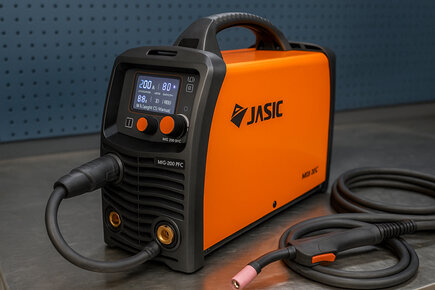
Find out which technical parameters of a welding machine most affect weld quality, performance, and energy consumption. Learn to read machine labels before making a purchase.
Modern welding machines offer dozens of numbers on the label, but only some of them significantly affect weld quality – and whether your investment will truly pay off. In the following chapters, we break down the key parameters every welder should know – from hobby users to industrial engineers.
⚡️Type of Welding Current (AC / DC)
- DC (Direct Current) – more stable arc, ideal for steel and stainless steel.
- AC (Alternating Current) – essential for aluminum due to oxide layer cleaning.
💡 Tip: Combined AC/DC machines are more expensive but more versatile – great for workshops welding various materials.
🔌Welding Current Range (Amperage)
Indicates the minimum and maximum current output the machine can provide.
- 40–160 A – for hobby use and thin sheets.
- 50–250 A – general workshop applications.
- 300 A+ – heavy profiles, industrial structures.
⏳ Duty Cycle
Percentage of time a welder can operate at rated current during a 10-minute interval.
- 60% @ 200 A means 6 minutes of welding and 4 minutes of cooling.
- Higher duty cycle = fewer interruptions and longer machine life.
🔋 Power Supply Voltage and Input
- 1 × 230 V – portable inverters for standard household outlets.
- 3 × 400 V – more stable arc, higher performance, ideal for workshop environments.
🔌Open-Circuit Voltage
Typically 50–90 V. Higher voltage helps arc ignition but requires quality insulation and safety systems.
🌡️ Cooling Type
- Air-cooled – simpler, lighter, up to ~ 250 A.
- Water-cooled – for continuous welding at high amperage, longer torch lifespan.
Wire / Electrode Diameter Range
The supported diameter range of the welder (and torch) determines its versatility and weld quality. Mismatch between wire/electrode diameter and machine output can cause arc instability, wire stuttering, or material burn-through.
The device must support the required filler material size:
| Process | Typically Supported Diameters | Application |
| MMA | 1.6 – 5.0 mm coated electrodes | Repairs, construction, heavy materials |
| MIG/MAG | 0.6 – 1.6 mm solid wire, 0.9 – 1.2 mm flux-cored wire | Automotive, steel frame production |
| TIG (filler rod) | 0.8 – 5.0 mm rods, tungsten electrode 1.0–4.0 mm | Precision stainless, aluminum, titanium |
💡Practical Tip:
- Thin sheets (≤ 1 mm) – choose Ø 0.6 mm wire (MIG) or filler rod ≤ 1.0 mm (TIG).
- Thick profiles (≥ 10 mm) – use wire 1.2 – 1.6 mm or electrode 4.0 – 5.0 mm and matching current of 250 A+.
- Before purchase, check whether the feeder supports the diameter and if the package includes suitable liner, rollers, and tips.
⚡️Protection and Insulation Class
- IP 23–IP 44 – resistance to dust and splashing water.
- Class F / H – thermal resistance of the transformer winding.
The welder’s label includes two important safety codes – IP (Ingress Protection) and the insulation class of the winding.
| Code | What it means | When it matters |
| IP 23 | Protected against dripping water up to 60° and solid objects > 12 mm | Standard workshop use, occasional outdoor transport |
| IP 44 | Protected against splashing water from all directions and particles > 1 mm | Construction work, rainy outdoor conditions |
| Class F (155 °C) | Coil insulation tolerates temperatures up to 155 °C | Standard for most inverters |
| Class H (180 °C) | Withstands up to 180 °C | Heavy industrial use, high duty cycles |
⚖️ Weight and Dimensions
A lightweight inverter (4–8 kg) is ideal for field installations; a robust source (30 kg+) offers higher performance but requires a trolley.
🧠 Control Features and Digital Equipment
- Synergic modes – the machine automatically adjusts voltage and current based on wire type.
- Pulse/Double Pulse – less spatter in MIG, smoother beads on aluminum.
- Hot Start / Arc Force / Anti-Stick – easier arc ignition in MMA.
- Bluetooth / USB logging – weld parameter logs, diagnostics, updates.
🔄 Summary
When buying a welder, pay attention primarily to the current range, duty cycle, power supply, and cooling type. Secondary parameters such as open-circuit voltage and digital features enhance comfort and safety. The better you know your welding tasks, the more precisely you'll choose a machine with the best price/performance ratio – and avoid disappointment during actual welding.