How to choose the right welding torch?
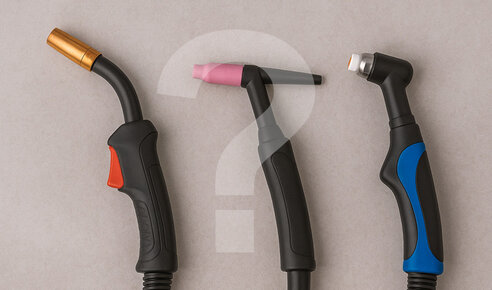
Choosing the right welding torch is a decision that affects the weld quality, production speed, long-term operating costs, and the welder's physical comfort. In the following sections, we discuss five key areas to consider when purchasing a torch – from the welding method to the ergonomics of the handle.
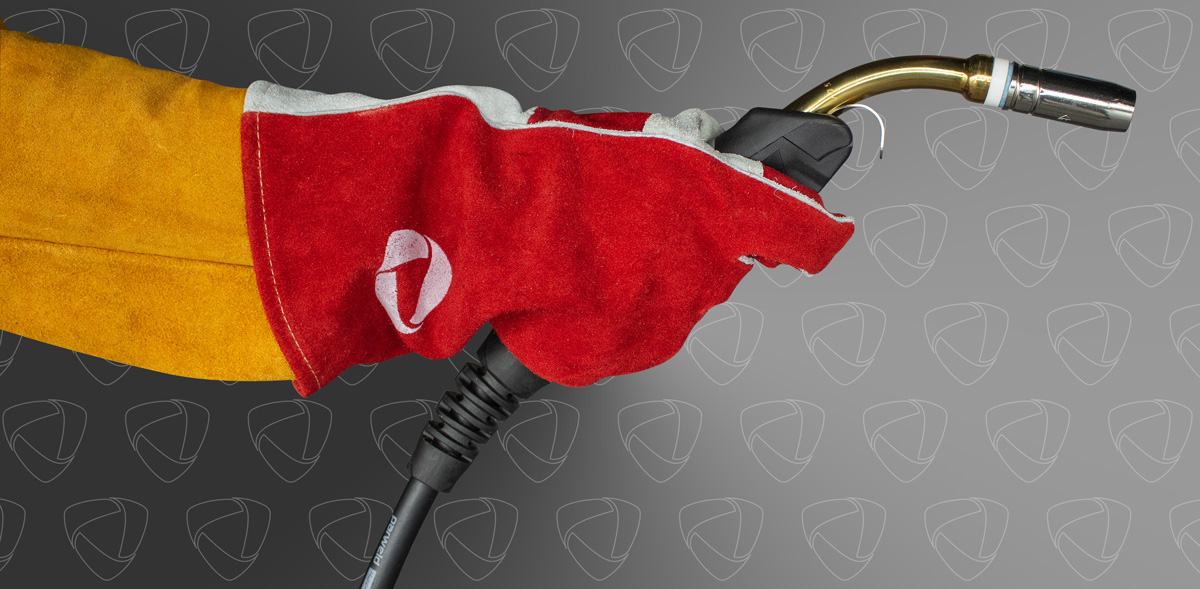
What to Consider When Choosing a Welding Torch?
Selecting a welding torch is a decision that affects the quality of welds, production speed, long-term operating costs, and the welder’s physical comfort. In the following sections, we explore five key areas you should consider when purchasing a torch – from the type of welding to handle ergonomics.
Type of Welding and Torch Application
(How do hobby and professional torches differ?)
Hobby / Occasional Welding
- Construction: lighter body, shorter cable (3–4 m), air cooling.
- Advantages: low purchase cost, easy maintenance, compact design.
- Limitations: lower duty cycle (30–40% at 150 A), faster wear of consumables, limited flexibility for thicker materials.
Semi-professional use (workshops, car repair shops)
- Construction: more robust brass body, 4–5 m cables, interchangeable necks at various angles.
- Advantages: higher current capacity (up to 250 A), modular design, better duty cycle.
- Limitations: slightly higher weight and price, need for higher quality shielding gas and wire.
Industry and Automation
- Construction: fully water-cooled torches 350–550 A, up to 100% duty cycle, Teflon liners for aluminum, robotic flanges.
- Advantages: continuous operation, minimal overheating, integration into robotic arms, long component lifespan.
- Limitations: high cost of power source and cooling unit, more complex maintenance.
💡Tip: If you weld less than 3 hours per week and don't exceed 5 mm steel thickness, a hobby torch is sufficient. For daily welding or aluminum, we recommend at least a semi-professional grade.
Torch power and cooling system
(💦Water-cooled vs. 💨air-cooled torches – which is better?)
🗞️Summary: An air-cooled torch is ideal for occasional or short welds. However, if you're working with thick materials, long seams, or in multi-shift operations, a water-cooled system will save downtime and prevent damage to the torch.
Cable Length and Flexibility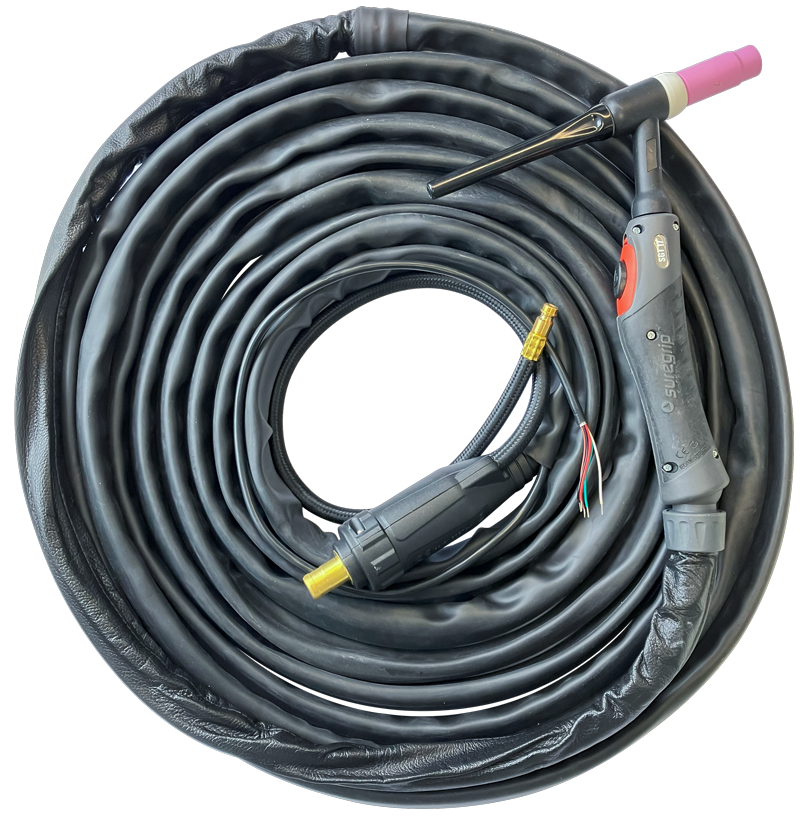
(Why is it important to have a sufficiently long and flexible cable?)
- Ergonomic reach: With a 4–5 m cable, the welder can reach the weld without pulling the power source. For large structures, consider extending to 6–8 m or using an intermediate bundle.
- Fatigue reduction: A quality coaxial bundle (sheath + liner + gas hose) has low friction, bends easily, and reduces resistance during precise torch movement.
- Wire protection: Rubber or polyurethane sheaths resist abrasion, sparks, and UV radiation. Cheap PVC cables harden, crack, and increase the risk of micro-breaks.
💡Tip: If you frequently weld overhead or in tight spaces, choose extra flexible bundles with swivel joints on the handle – they prevent liner twisting and extend service life.
Consumable Parts and Their Replacement 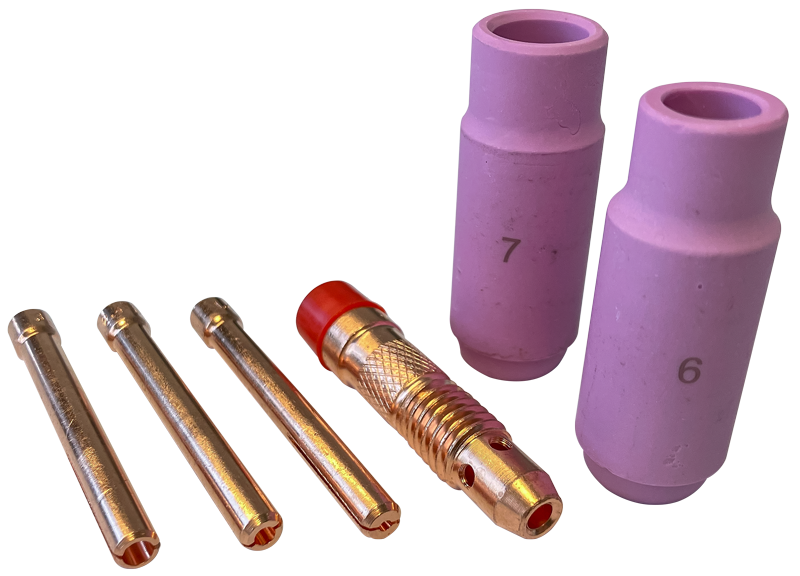
(Which torch parts wear out most often?)
- Contact tips – wear out due to current erosion and wire friction.
- Nozzles / gas tips – clog with spatter, may deform from heat.
- Gas diffusers – if threads burn out, they leak and cause turbulence.
- Liners – cheap steel wire causes clogging or rust; use Teflon for aluminum.
- Insulating rings and O-rings – age from heat and may cause gas leakage.
🔧Maintenance Schedule
- Daily nozzle cleaning with anti-spatter spray or brush.
- Weekly visual inspection of tips and diffusers.
- Monthly liner replacement when using aluminum wire or after 150 kg of steel wire.
- Always keep at least 5% of torch value in spare parts in stock – this prevents unplanned downtime.
Ergonomic Design and Workplace Comfort
(How does proper grip reduce fatigue and improve accuracy?)
- Handle shape: Smooth “pistol grip” fits the palm, reducing finger and forearm tension.
- Surface: Non-slip rubber or soft TPE prevents slipping of sweaty hands.
- Trigger button: Low resistance, clear click, option for 2-step (2T/4T) operation for long welds without cramping.
- Balance: Center of gravity as close to the handle as possible – the torch “doesn’t drop” from the hand and allows more precise movements.
- Rotating neck / interchangeable angles: Ergonomic angles of 30°, 45°, and 60° help adapt the torch to specific welding positions (PA–PD).
🩹Health benefit: An ergonomic torch reduces vibrations and static strain in the hands, helping to prevent carpal tunnel syndrome and chronic shoulder fatigue.
🔄Summary
- Define what and how much you will weld – choose a hobby, semi-professional, or industrial torch accordingly.
- Select an appropriate cooling system – air for occasional tasks, water for long and demanding welds.
- Don’t skimp on the cable – length and flexibility directly affect ergonomics and weld quality.
- Expect consumables – cheap tips and nozzles wear quickly and increase downtime.
- Prioritize ergonomics – a comfortable torch reduces fatigue, increases precision and productivity.
Investing in a quality welding torch pays off through reliable joints, less downtime, and long-term health protection. Don’t base your choice on price alone – consider the duty cycle, cooling system, spare parts availability, and above all handle ergonomics. Your hands – and your welds – will thank you.
| Comparison | Air cooling | Water cooling |
| Duty cycle | 35 – 60 % at 180 – 250 A | 60 – 100 % at 300 – 550 A |
| Torch weight | Lower, 0.6 – 1.0 kg | Higher, 0.9 – 1.3 kg |
| Complexity | Simple connection | Requires cooling unit, hoses and quick connectors |
| Cost | Cheaper torch and maintenance | Higher investment, more expensive parts |
| Typical use | Hobby, maintenance, thin sheets | Industry, long continuous welds, high currents |