- Welding machines
- Welding torches
- Additional welding materials
- Abrasive & Cutting Material
- Protective equipment and clothing
- Tools
- Accessories

- Bevellers

- Cordless hand tools

- Accumulator multi-tool

- Batteries for cordless tools and chargers

- Cordless Extrusion and Hot Melt Guns

- Cordless Grease Guns

- Cordless Tool Sets

- Cordless compressors and pumps

- Cordless drilling and demolition hammers

- Cordless drills

- Cordless garden equipment

- Cordless grinders

- Cordless impact wrenches

- Cordless riveting machines

- Cordless saws

- Cordless soldering irons

- Cordless work lights

- Testers, Meters & Inspection Cameras

- Accumulator multi-tool
- Hand Tools

- Magnetic drills

- Power tools

- Punchers

- Storage systems

- Accessories
- Other products


Welding torches


MIG/MAG and TIG welding torches and plasma torches for workshops, service and production. Solutions for precise, stable and efficient metal welding. Welding torches ensure precise control of the welding process, transfer of welding current and, depending on the technology, supply of shielding gas or welding wire. They are used for MIG/MAG, TIG and plasma welding in workshops, service centres, assembly operations and industrial production. When choosing a torch, it is important to consider the welding process, maximum current, duty cycle, torch length, cooling method and compatibility with the welding equipment. A high-quality torch contributes to a stable arc, precise weld control and reliable operation even under prolonged loads. Depending on the specific application, you can choose air-cooled or liquid-cooled torches, different cable assembly lengths and versions suitable for both light service work and demanding production applications.
What are the main types of welding torches❓️
The right choice of welding torch – whether for a workshop, repair service, or large production hall – has a huge impact on quality, speed, and overall costs of manufacturing or repair. Below you will find an overview of the four most commonly used groups of torches, an explanation of their principle, and practical tips on when to use them.
🔧MIG/MAG welding torches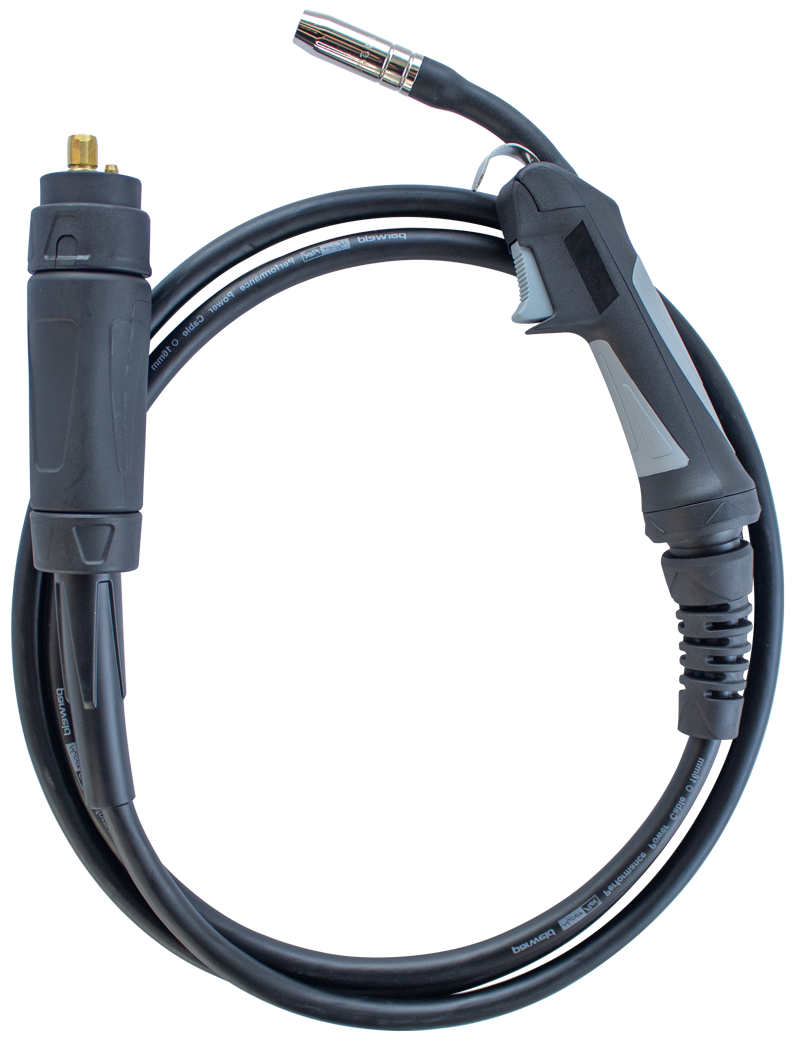
MIG/MAG welding torches are designed for semi-automatic welding, where the welding wire is fed automatically through the torch. They are ideal for welding unalloyed, alloyed, and aluminum materials. These torches provide a stable arc, consistent gas flow, and efficient cooling. They are available in both air-cooled and water-cooled versions, featuring high durability, an ergonomic design, and easy handling – making them suitable for both industrial and workshop use.
Why are they ideal for steel and aluminum?
MIG/MAG torches are perfect for welding steel and aluminum thanks to their ability to ensure:
Continuous wire feeding: They allow smooth and fast welding without frequent interruptions, which is ideal for both steel and aluminum joints.
Protective atmosphere: They use shielding gas (inert for MIG – e.g. argon, active for MAG – e.g. CO₂ or mixtures) that protects the weld from oxidation, which is especially critical when welding aluminum, as it is prone to oxide formation.
High welding speed: The MIG/MAG process is fast and efficient, making it advantageous for welding large steel structures as well as thin-walled aluminum parts.
Versatility and adaptability: By changing the wire, torch, and gas, it is easy to switch from steel to aluminum. Special MIG torches with a Teflon liner and drive rollers are available for soft aluminum wire.
High-quality and clean welds: MIG/MAG torches provide a stable arc and a good weld appearance with minimal spatter, which is important for visible and precision welds.
Thanks to these properties, MIG/MAG torches are widely used in mechanical engineering, the automotive industry, and in the production of aluminum structures.
✨TIG welding torches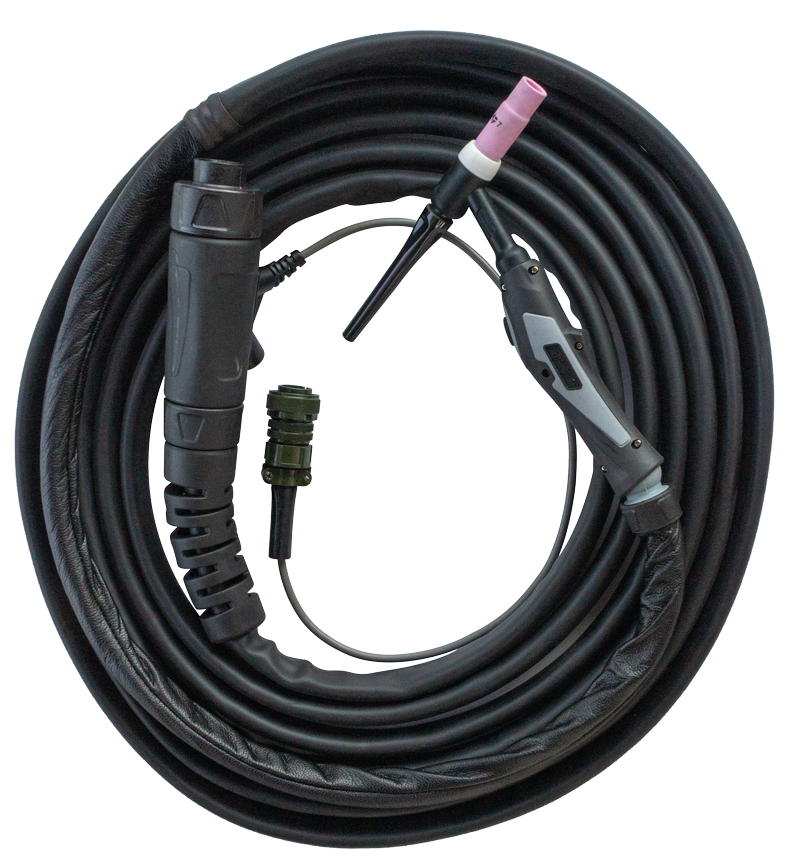
TIG (Tungsten Inert Gas) welding torches are designed for welding with high precision and weld cleanliness. They use a non-consumable tungsten electrode and an inert gas (most commonly argon) that protects the weld area from oxidation. They are ideal for welding thin-walled materials, stainless steel, aluminum, and other non-ferrous metals.
High precision and quality welds
TIG torches allow precise control of heat and filler material, resulting in very high-quality, smooth, and strong welds without spatter. For this reason, they are used mainly in the food industry, chemical industry, aerospace, and wherever weld cleanliness and appearance are crucial.
Which materials are most suitable for TIG welding?
TIG welding is ideal for metals that require precise processing, clean welds, and high-quality joints. The most suitable materials include:
Stainless steel
- TIG welding provides clean, corrosion-resistant joints without spatter.
- Frequently used in the food and pharmaceutical industries.
Aluminum and its alloys
- Thanks to the AC mode and suitable torches, TIG is ideal for welding aluminum.
- Provides high-quality welds even on thin-walled parts.
Copper and its alloys (e.g., bronze, brass)
- TIG allows precise temperature control, which is important when welding materials with high thermal conductivity.
Carbon (structural) steel
- Although more often welded using MIG/MAG methods, TIG is used when higher weld precision is required.
Titanium and titanium alloys
- Thanks to the inert gas, TIG protects titanium from oxidation – crucial in aerospace, medicine, and high-tech manufacturing.
TIG welding is therefore especially suitable for thin sheets, sensitive materials, and demanding applications where weld quality, strength, and appearance are essential.
⚡Plasma torches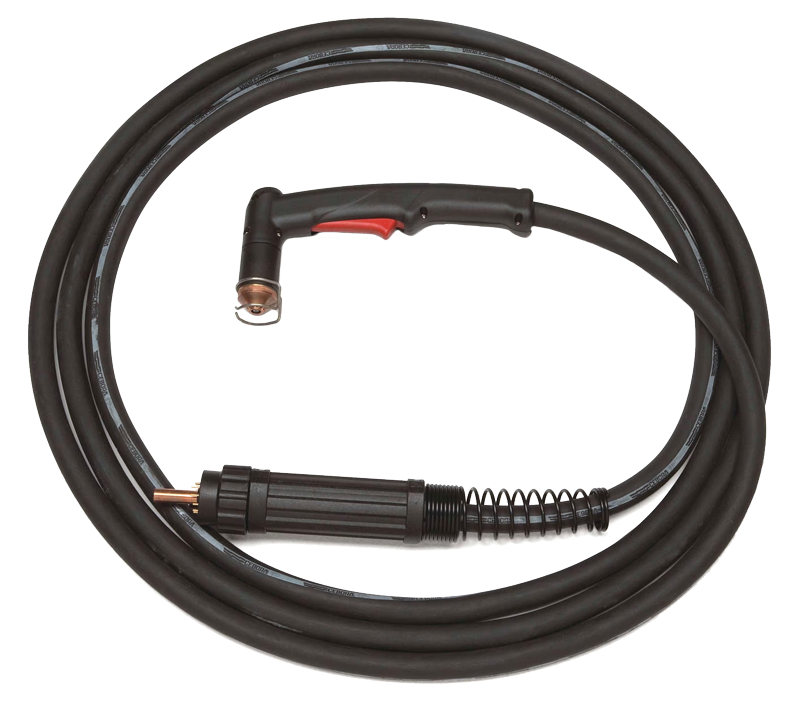
How does plasma cutting work?
Plasma cutting is a process in which metals are cut using plasma – a hot ionized gas. Plasma torches use an electric arc created between the electrode inside the torch and the material being cut. This arc ionizes the compressed gas (e.g., air, argon, or nitrogen), producing plasma with a temperature of up to 30,000 °C.
How it works step by step:
- Arc ignition: An electric arc is created in the torch between the tungsten electrode and the nozzle.
- Gas ionization: The compressed gas passes through the arc, turning into plasma – an extremely hot and fast gas stream.
- Cutting the material: The plasma jet melts and blows away the molten metal, producing a narrow and precise cut.
✅ Advantages of plasma cutting:
- Fast and precise cutting of conductive metals (steel, aluminum, stainless steel, copper).
- Ability to cut different thicknesses – from thin sheets to thick structures.
- Less heat-affected zone compared to oxy-fuel cutting.
- Clean cut with no need for additional finishing.
Plasma torches are commonly used in locksmithing, steel structure manufacturing, auto repair shops, and general metalworking workshops.
Who is this technology suitable for?
Plasma cutting is a universal, efficient, and precise technology suitable for a wide range of users and industries. Those who benefit the most include:
Metalworking and locksmith workshops
- Ideal for fast and precise cutting of steel, stainless steel, or aluminum sheets.
- Suitable for daily work with different material thicknesses and shapes.
Industry and manufacturing
- Used in steel structure manufacturing, mechanical engineering, and the construction industry.
- Suitable for series production of parts, quick repairs, and shaped cuts.
Auto repair shops and body shops
- Suitable for repairs and modifications of car bodies, frames, and metal components.
- Fast cutting of both thin and thicker sheets without excessive overheating.
Home users and hobby welders
- Portable plasma cutters are ideal for home users who need quality metal cutting.
- Easy operation and a good price/performance ratio.
Artistic blacksmithing and metal design
- Possibility of precise cutting of complex shapes and decorative patterns.
Suitable for anyone who needs to:
- Cut conductive metals (steel, stainless steel, aluminum, copper…)
- Divide material quickly and cleanly,
- Work with different material thicknesses,
- Reduce the need for additional finishing of the cut.
Plasma cutting is therefore an excellent choice for both professionals and hobbyists who require efficient, clean, and flexible cutting of metal materials.
🔥Oxy-fuel torches
When is it worth investing in an oxy-fuel torch?

Investing in an oxy-fuel torch is worthwhile when you need to:
- Cutting or welding thick metal materials – oxy-fuel torches are especially suitable for cutting and welding thick steel plates and structures.
- Work in environments without electricity – oxy-fuel welding and cutting do not require electric current, only a supply of oxygen and fuel gas (e.g., acetylene), which is ideal for field or mobile work.
- Low equipment costs – if you are looking for a cheaper solution compared to electric welding technologies, oxy-fuel is an economical choice.
- Simple and versatile technology – suitable for basic repairs, maintenance, and welding materials where extreme precision is not required.
- Cutting metals in workshops or construction – especially with thick steel structures or in places without available electric power.
Investing in an oxy-fuel torch makes sense mainly when working with thick metals, in the field, and wherever a simple, robust, and self-sufficient welding or cutting technology is needed.
Suitable applications and safety measures.
✅ Suitable applications:
- Cutting and welding thick steel plates and structures – ideal for construction, repairs, and maintenance.
- Mobile and field work – used where electricity is not available, such as on construction sites or in workshops without power supply.
- Basic welding and cutting of metals – suitable for workshop repairs, metal fabrication, and machine maintenance.
- Repairs and modifications of railway tracks, pipelines, or large metal frames.
⚠️ Safety measures:
- Work in a well-ventilated area – prevents the accumulation of flammable gases and reduces the risk of explosion.
- Use protective equipment – welding gloves, filter glasses, protective clothing, and a helmet.
- Proper storage and handling of gases – ensure that oxygen and fuel gas cylinders are stable and kept away from sources of sparks or fire.
- Check hoses and connections – regularly check for leaks and the condition of hoses to avoid gas escape.
- Use correct ignition and flame handling techniques – minimize the risk of flashback.
- Follow fire safety regulations – keep a fire extinguisher ready and ensure fire protection measures are in place.
The oxy-fuel torch is a powerful and reliable tool, but it requires strict adherence to safety rules due to the use of flammable gases and high temperatures.
Why is it important to choose the right welding torch?
Choosing the welding torch is one of the most critical decisions in welding, right after selecting the welding method itself and the power source. The torch is the “extended hand” of the welder – it directly affects the shape, cleanliness, and strength of the weld, as well as work speed, fatigue level, and long-term costs of consumables. In the following paragraphs, we will look at why the quality of the torch plays such an important role and how the right choice can significantly improve the efficiency of the entire operation.
Impact of torch quality on the final weld
➡️Arc stability and smooth wire feeding
The contact tip, wire guide, and gas nozzle must be designed to keep the arc stable even during position changes or slight current fluctuations. High-quality torches use precisely machined brass or CuCrZr tips and low-friction liners, which prevent wire jamming and minimize micro-interruptions of the arc. The result is a homogeneous weld without pores and spatter.
➡️ Optimal shielding with protective gas
A well-designed gas nozzle creates a laminar gas flow that perfectly protects the weld pool from the surrounding atmosphere. Poor-quality or damaged nozzles cause turbulence – oxides, pores, and cracks appear in the welds. In addition, gas consumption increases, raising operating costs.
➡️ Thermal stability and duty cycle
The materials of the torch body (alloy housing, insulating inserts, handle) must withstand long-term radiant heat. Cheap torches tend to overheat, deform nozzles, or burn through insulation, which can cause a short circuit or injury. Higher-class torches often feature water cooling and a duty cycle of 60–100% at 350 A, allowing longer welding without breaks and without the risk of damage.
➡️ Precision and weld aesthetics
The ergonomic handle shape, balanced weight, and natural tube angle enable the welder to hold the torch steadily even in hard-to-reach positions. Better control = straighter welds, less grinding, and less rework.
How torch selection affects work efficiency
| Efficiency factor | Feature of a quality torch | Specific benefit |
| Productivity | High duty cycle, effective cooling | Less downtime for cooling, more welds per shift |
| Operating costs | Longer lifespan of tips and nozzles, lower gas consumption | Reduced costs for consumables and gas |
| Work speed | Smooth wire feeding, minimal spatter | Less time spent cleaning the weld and making repairs |
| Safety and fatigue | Ergonomic handle, lightweight cable | Welder gets less tired, reduced risk of mistakes and accidents |
| Production flexibility | Quick replacement of consumables, modular necks | Easy adaptation to different materials or positions |
Shorter downtime and higher daily output
Water-cooled torches with good thermal management do not need to “rest” after a few minutes of welding. This is crucial especially in series production, where every arc shutdown means a delay for the entire line.
Lower consumable costs
High-quality alloy tips and nozzles last for dozens of meters of weld without replacement. Cheap alternatives need to be changed more often – not only do they cost money, but every replacement also represents a time loss.
Less grinding and rework
If the torch ensures a stable arc and consistent shielding gas coverage, the weld is clean. Grinding off only the discoloration is much faster than cutting out a porous or excessively spattered joint.
Increased ergonomics = fewer errors
A light and well-balanced torch reduces wrist strain, which is crucial during all-day work. A tired welder makes mistakes; investment in ergonomics pays off in the form of lower defect rates.
Conclusion
The right welding torch is not just an “attachment” but a strategic part of the welding process that influences:
- Weld quality: stable arc, clean weld pool, minimal spatter.
- Costs: longer component life, lower gas consumption, fewer repairs.
- Productivity: higher duty cycle, faster job completion.
- Welder’s health and safety: ergonomic handle, reduced risk of injuries.
When purchasing, pay attention not only to the price but also to materials used, cooling system, availability of spare parts, and user reviews. Investing in a quality torch will pay back in the form of reliable welds, more satisfied workers, and significantly lower operating costs.

MIG torch MB ERGO 25 AK 4m (004.0313) Ergo
73,80 € incl. tax
Grinder for tungsten electrodes Ultima-TIG UT 220 (88897022)
2 706,00 € incl. tax
Grinder for tungsten electrodes Ultima-TIG-CUT (88897522)
3 813,00 € incl. tax
Table holder for Neutrix tungsten electrode grinder (44510270)
92,69 € incl. tax
TIG torch JASIC PARKER SGT17-S4 /4m, UD (51002865)
141,45 € incl. tax
MIG Nozzle DINSE pr. 15 mm (6390154150) DIX 1-3-5415A MSZ/MCZ
21,30 € incl. tax
DINSE Insulator (6390250000) DIX 2-3-500 MSZ/MCZ
4,34 € incl. tax
Tip 1.2mm M8x45mm DINSE (629035412) DIX 3-2-1.2 SR MSZ/MCZ
3,63 € incl. tax
DINSE Clamping Nut (6390454000) DIX 4-2-MAS MSZ/MCZ
6,36 € incl. tax
Threaded sleeve for M8 DINSE tip (628150008) DIX GS 2-M8 MSZ/MCZ
16,24 € incl. tax
MIG Welding Torch DINSE DIX MQZ 304.neo-4 SAZ /4m (620324441)
427,47 € incl. tax
MIG Welding Torch DINSE DIX MQZ 304.neo-4 N /4m (620324444)
347,13 € incl. tax
Power Pin MIG DINSE Adapter (639118033) DIX PP 124 for Fronius TPSi and TransSteel
80,29 € incl. tax
Power Pin Adapter MIG DINSE (639118025) DIX PP 117
80,29 € incl. tax
MIG Nozzle DINSE pr.15x62mm (629010415) DIX 1-2-415 MSZ/MCZ 304 (SAZ/N)
19,58 € incl. tax
Tip 1.2mm M8x28mm DINSE (629030112) DIX 3-2-1.2 M8 MSZ/MCZ
1,80 € incl. tax
MIG DINSE Gas Distributor (629100324) DIX 10-2-304 MSZ/MCZ 304.PLUS
12,46 € incl. tax
Steel Bowden cable DINSE pr. 2.2mm/4.5m DIX DS 4/2.2-4.5 (623000345)
8,67 € incl. tax
MIG Welding Torch DINSE DIX MQ 230.neo-4 N /4m (610212442) 250A
176,44 € incl. tax
MIG Nozzle DINSE pr.13mm (6190103120) DIX 1-1-312 TR MS/MG 230 (SA/N)
9,18 € incl. tax
Tip 1.0 mm M6x24 mm DINSE (619030010) DIX 3-1-1.0 MS/MG 230, MDW 300, MSZ 230
1,16 € incl. tax
Tip holder DINSE M6 (619040010) DIX 4-1-K MS/MG 230, MDW 300, MSZ 230
4,17 € incl. tax
DINSE Insulator (619100202) DIX 10-1-222 DIX MS/MG 230 (SA/N)
3,01 € incl. tax
MIG Welding Torch Body DINSE MQ 230.neo 45deg. (6190632310) DIX 6-1-230.neo (SA/N)
53,07 € incl. tax
Which models are best for specific tasks?
At Valtec.sk you will find dozens of torches – from lightweight guns for hobby users to robust industrial sets with water cooling. To help you quickly navigate the range, we have divided the recommended models into three typical scenarios and added an indicative price list and key parameters.
Welding torches for beginners
Ideal choice: MIG/MAG torch ABICOR BINZEL MB 15 AK – 4 m, 150 A
- Air-cooled torch with a max. duty cycle of 150 A (mixed gas) / 180 A (CO₂) – sufficient for sheets up to 3 mm and shorter welds.
- Wide wire range 0.6 – 1.0 mm covers standard steel and stainless steel.
- Compact handle and 4 m cable make handling easy in the garage or on site.
Why for hobby use? It weighs less than a kilogram, doesn’t require an external cooler, and consumables (M6 tips, MB 15 nozzles) cost only a few euros.
Professional torches for long-term welding
Universal MIG/MAG “workhorse”: MB 36 GRIP – gas-cooled
- 300 A (CO₂) duty rating at 60% duty cycle – handles thicker profiles without the need for water cooling.
- “GRIP” handle with ball joint minimizes fatigue during multi-hour welding.
Precise TIG for stainless steel and aluminum: LORCH a-LTW 3000 DD – water-cooled
- 320 A DC / 230 A AC at 100% duty cycle.
- Eight-meter cable and swivel head allow welding inside large tanks or frames without repositioning.
- Water cooling keeps the torch neck temperature well below 50 °C, so consumables last much longer than with air-cooled alternatives.
When to choose the professional class? If you weld daily (car repair shop, locksmith workshop, food production) and the current often exceeds 200 A, a water-cooled system will save you downtime and money on worn tips and nozzles.
Best torches for industrial use
Heavyweight for structural manufacturing: MIG torch MB 501 D – 5 m, 500 A
- Water cooling, duty cycle up to 100% – ideal for multi-shift operation and heavy structural steels.
- Robust body with interchangeable necks withstands rough handling in production.
For automation and robotics: the water-cooled MB EVO PRO 501 D series offers a reinforced central connection and standardized mounting for manipulators. The combination of a lightweight hose bundle and a precise ball joint minimizes robot path deviations.
Comparison of welding torches on Valtec.sk
| Segment | Model (example) | Cooling | Max. current / duty cycle | Typical use |
| Beginner / hobby | MB 15 AK 4 m | Air | 150 A @ 60 % | Home repairs, bodywork |
| Professional | MB EVO PRO 36 4 m | Air | 300 A @ 60 % | Car repair shop, locksmith |
| LORCH a-LTW 3000 DD 8 m | Water | 320 A @ 100 % | Stainless steel, aluminum, food industry | |
| Industry | MB 501 D 5 m | Water | 500 A @ 100 % | Steel structures, heavy machinery |
How to choose?
- Evaluate current and weld length – if you exceed 200 A for more than a few minutes, invest in water cooling.
- Focus on ergonomics – for long welds, a quality handle and lightweight cable will quickly pay off in productivity.
- Plan for the future – if you consider automation, choose a series with robotic interface today; it will save you conversion costs.
- Check consumables availability – at Valtec-shop.com


Popular product brands























ZVARCENTRUM - VALTEC
VALTEC spol.s r.o., in the ZVARCENTRUM division, focuses on the entire range of products necessary not only for welders. Sales of welding equipment and accessories, attachments and consumables, power tools, AKU and hand tools, and sales of technical gases. In terms of services, we offer professional servicing of welding equipment, accessories and tools and sales of technical gases.
Address
Opening hours
Contact
VALTEC spol. s r. o.
Lieskovská cesta 13
962 21 Lieskovec
View on the map
| Monday: | 7:00 - 16:00 |
| Tuesday: | 7:00 - 16:00 |
| Wednesday: | 7:00 - 16:00 |
| Thursday: | 7:00 - 16:00 |
| Friday: | 7:00 - 16:00 |
| Saturday: | Closed |
| Sunday: | Closed |

Lieskovská cesta 13
962 21 Lieskovec